The Pinboard Papers: How to Read, Write and Survive Your Village Noticeboard
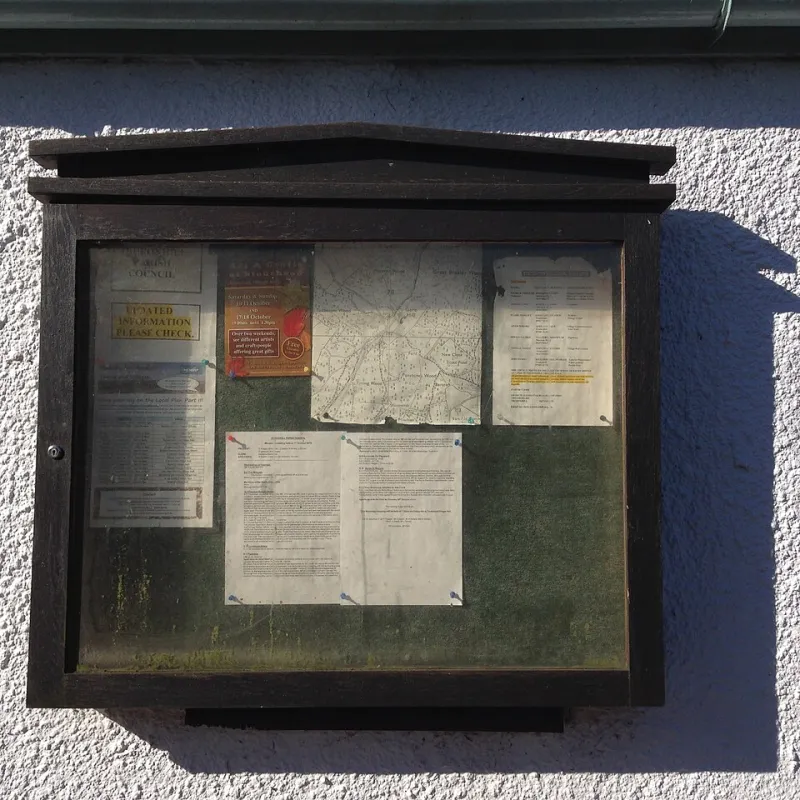
Photo: James Harrison , CC BY-SA 2.0, via Wikimedia Commons
The village noticeboard is Britain's least glamorous social network. It has no algorithm, no notifications and no way to mute your neighbour's raffle. What it does have is a laminated A4 sheet, four drawing pins and a surprisingly efficient grip on local life. At UshVP we treat the parish pinboard as infrastructure — slightly wonky infrastructure, usually behind glass and smelling faintly of damp — and it deserves a proper field guide.
A quick anatomy lesson
Every good noticeboard is a palimpsest. Under the current posters there are ghosts of last month's quiz night, a curl of yellowed paper advertising a mobile library, and at least one drawing pin that has been there since the reign of a previous vicar. The layers tell you what matters locally: school fete, church coffee morning, dog training, lost cat, parish council agenda, someone selling a exercise bike that is definitely not being used as a coat rack.
The laminated A4 is the local equivalent of a blue tick. It says someone has thought about the weather, and therefore about you. A plain sheet of paper flapping at one corner says the event is either very informal or already over.
The etiquette of pinning
There are rules, even if nobody has written them down. The first is simple: never cover a notice that is still in date. Pin beside it, above it or below it, but do not slap your yoga class over a funeral announcement. That is how noticeboard wars start.
The second rule is about removal. If your event has passed, take your notice down. Leaving it up for three weeks after the quiz night is not optimism; it is litter with a drawing pin in it. The third rule is the unspoken hierarchy of placement. Eye level is prime. The middle of the board is the equivalent of a shop window. The bottom corner is where notices go to be read by dogs and very small children.
And yes, the passive-aggressive over-layering is real. You can often date a noticeboard by the number of posters pinned directly on top of each other, each one slightly more desperate than the last. A good board is edited, not just filled.
How to write a notice that gets read
Start with the thing people need to know, not the thing you want to say. 'Coffee Morning' is a headline. 'A message from the fundraising sub-committee' is a warm-up act. Put the what, when and where in the first three lines, and make the date big enough to read from the other side of the porch.
Use plain words. 'Saturday 14 November, 10am to noon, village hall' beats 'An opportunity to engage with community refreshment provision' every time. Include a contact number or email, and check that it is actually readable. If you are using tear-off strips, cut them properly and use a decent pair of scissors. Ragged strips say 'we ran out of time', which is not the message you want before a bake sale.
A little colour helps, but not too much. One bright heading is friendly; six fonts and a clip-art bee is a cry for help. Laminate if the board is outside. Use drawing pins at all four corners, not one sad pin in the middle. And if you are advertising something free, say so early. People will cross a village for the word 'free'.
Placement and timing
Timing is half the battle. For a weekend event, pin your notice on Tuesday or Wednesday. Too early and it becomes wallpaper; too late and people have already made other plans. For a recurring club, put a fresh notice up at the start of each month rather than leaving the same one to fade into beige.
Placement matters too. The best spot is usually just inside the door of the shop, hall or church porch, where people pause anyway. If the board is glass-fronted, avoid the bottom third unless your audience is mainly toddlers. If you are allowed to choose, go for the middle-right: it catches the eye without covering the parish council's emergency number.
Odd notices readers have sent in
Readers of UshVP have sent in some genuinely excellent examples over the years. One board carried a lost tortoise notice that read: 'Answers to Kevin. If found, do not offer lettuce — he is on a diet.' Another advertised 'Yoga for the over-70s. Bring a mat and a sense of balance.' A parish council agenda once included the item 'Dog fouling — continued', which raised more questions than it answered.
Then there was thefor sale notice for an exercise bike: 'Used twice. Now a coat rack. Buyer collects, no helmet needed.' You have to respect the honesty.
The quiet usefulness
The noticeboard is not trying to be clever. It is trying to tell you that the hall is booked, the raffle needs prizes and someone has found a tortoise. That is a public service. It is also one of the last places where a notice costs nothing, reaches the people who actually walk past, and does not require you to agree to cookies.
So next time you see a curling corner or a laminated A4, give it a read. And if you have a notice of your own, pin it straight, date it clearly and take it down when it is done. The board will thank you. Quietly, and in the manner of all good local infrastructure.