Glühweinomics: A Cold-Handed Guide to Britain’s Christmas Markets
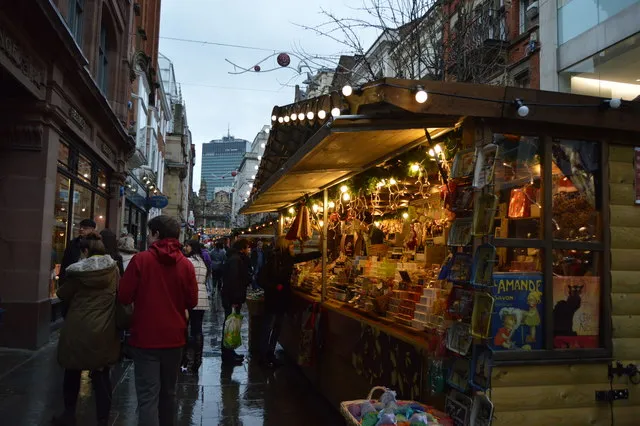
Photo: N Chadwick , CC BY-SA 2.0, via Wikimedia Commons
There is a moment, usually around the third fake snow machine and the second rendition of ‘Fairytale of New York’, when a British Christmas market stops being a charming European import and becomes a full-contact winter sport. The air smells of hot sugar, diesel generators and someone else’s damp coat. Your fingers have gone the colour of a Quality Street wrapper. And somewhere ahead, a wooden chalet is selling wax melts shaped like miniature puddings at four for a tenner.
This is not a review of any single market. Think of it as a field guide to the whole peculiar ecosystem — from the big-city German-style sprawls in Birmingham and Manchester to the smaller cathedral-square affairs in Winchester, York and Bath. The stalls change, the postcodes change, but the archetypes are as reliable as a mince pie best-before date.
The Archetypes, Roughly Ranked
1. The Inevitable Candle and Wax Melt Stall. It will find you. You do not find it. You will smell it before you see it — a heady fog of vanilla, cinnamon and something labelled ‘Winter Thaw’. Resistance is futile, but so is buying: you already have three unlit wax melts from last December in a drawer. Rank: unavoidable.
2. The Painted Wooden Sign Stall. Sells roughly forty variants of ‘Gin & Tonic Time’ and ‘Live, Laugh, Sauvignon’. The signs are always slightly too big for the car boot and slightly too heavy for the walk back to the station. Rank: dangerously tempting after one mulled wine.
3. The Cheese Truckle Van. A genuine public service. A waxed truckle of mature cheddar the size of a small dog, sold with a tiny wooden knife you will lose by Boxing Day. Rank: high. Always high.
4. The Bratwurst Queue. The queue is not a queue; it is a social contract with a smoke machine. The bratwurst is fine. The onions are better. The napkin situation is a scandal. Rank: worth it once, never twice.
5. The ‘Artisan Gin in a Bauble’ Stall. A festive way to spend £28 on 5cl of something that tastes like a Christmas tree had a fight with a sherbet lemon. The bauble is the real purchase. Rank: gift-shop energy.
6. The Charity Tombola. The only stall where you can win a tin of soup and a small bottle of bubble bath while genuinely feeling good about yourself. Rank: quietly excellent.
7. The Choir. Usually positioned near the queue for the toilets, singing ‘O Come All Ye Faithful’ with the weary precision of people who have done this six times already today. Rank: essential. Drop a coin.
Mulled Wine Mathematics
Here is where the season gets serious. Mulled wine pricing has drifted upward in the way of all things, and 2026 is no exception. Expect to see £6.50, £7, and — in the more ambitious postcodes — £8.50 for a paper cup that is somehow always two-thirds full.
The maths is not just the headline price. It is the cup deposit. Some markets charge a pound or two for a reusable cup, refundable on return. Fine in theory. In practice, you are four cups deep, holding two cups because your friend has wandered off to look at a man making a wooden reindeer, and the deposit system has quietly become a small savings account you will never reclaim.
The other trap is the ‘alcohol-free glühwein’. It costs the same, tastes like hot Ribena with a bay leaf in it, and gives you none of the warming benefits. Unless you are driving, skip it and buy a hot chocolate with too much cream instead. At least the cream is honest.
And a word on the ‘traditional’ mug. If it is shaped like a boot, a snowman or a small chalet, you will pay a premium and then have to carry it around for two hours. Only buy it if you genuinely want a boot-shaped mug at home. It will not become a useful object. It will become a pen holder, then a nuisance.
Crowd Dynamics and the Bottleneck Problem
Every market has a pinch point. Usually it is where the bratwurst smoke meets the churros van and a pram, a Labrador and a man with a tripod all arrive at once. The trick is to walk the perimeter first. Do a full lap before buying anything. This does three things: it locates the exits, it reveals which stalls are actually worth queueing for, and it stops you from panic-buying a decorative sign in the first four minutes.
Watch for the ‘stop-dead photographer’ — someone who halts without warning to frame a string of lights. And the ‘sideways shuffler’, who moves diagonally across the flow while reading a stall menu. Keep your elbows loose, your pace steady, and never follow a group of six who are clearly waiting for a seventh.
If you have children, agree a meeting point early. If you have a dog, leave it at home. The market is not dog-friendly in practice, however many water bowls are put out. Too many feet, too much dropped sausage, too much excitement.
Getting Out With Your Dignity
The classic error is the ‘one last loop’. You have had a mulled wine, bought a cheese truckle, and are now convinced you have time for a final sweep. You do not. The one last loop is where budgets go to die and where you buy a candle shaped like a Christmas tree that you will never light because it is too pretty.
My advice: set a cash limit before you go. Leave the card in a pocket you cannot reach without taking off a glove. Buy the cheese early — it is the only purchase you will definitely use. And if a wax melt stall calls to you on the way out, remember the drawer at home. It is full of last year’s good intentions.
Britain’s Christmas markets are not perfect. They are crowded, overpriced and occasionally smell of wet tarpaulin. But they are also one of the few places where a whole town agrees to stand outside in the dark and pretend to be cheerful. Go early, go once, go with a plan. And keep your fingers in your pockets between the mulled wine and the cheese.
That is the whole field guide. The rest is just queueing.