The Last Free Living Room: Notes From Britain’s Bus Shelters
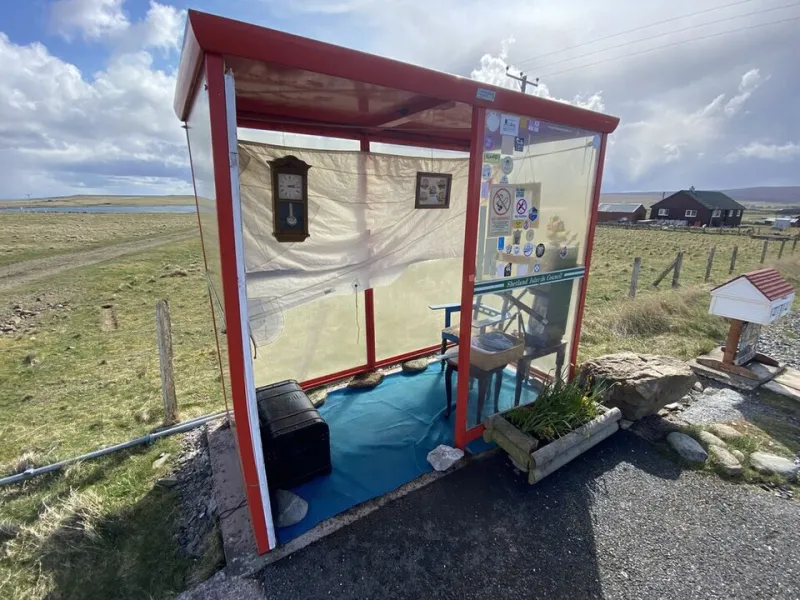
Photo: Iain Lees , CC BY-SA 2.0, via Wikimedia Commons
The bus shelter is a strange bit of British infrastructure. It is designed for one job — keeping the rain off people who would rather be somewhere else — and yet it keeps becoming something more. In November 2026, with dusk arriving before the school run is over, these little glass and concrete boxes are doing more community work than most village halls. You can learn a lot about a place from its shelter. Not from the timetable, which is usually wrong, but from what has been left behind, knitted onto it, written on it and whispered inside it.
A Glass Box With a Civic Streak
There are several species of bus shelter in Britain. The classic 1990s glass box, with a bench that is roughly 40% armrest and 60% apology. The rural wooden lean-to, held together by ivy and optimism. The concrete bunker that smells faintly of wet dog and 1987. Then there is the modern 'living roof' stop, which looks lovely in a council brochure and is basically a hedge with a bus stop attached.
What they share is a curious civic streak. A shelter is one of the last places you can stand for twenty minutes without buying anything, being asked to move on, or pretending to look at your phone with purpose. It is a waiting room with no walls, no receptionist and no obligation to make conversation. That makes it unusually democratic. Everyone is equally late. Everyone is equally damp. Everyone is, briefly, in it together.
The Noticeboard Under a Roof
Look closely and the shelter becomes a parish noticeboard with a roof. There is the hand-painted timetable in wonky marker pen, corrected in biro because the 08:42 has become the 08:47. There is the laminated notice for a yoga class in the Methodist hall, Thursdays at seven, all welcome. There is a missing cat called Bella, a tabby, very friendly, will come for Dreamies. There is a phone number for a man who fixes lawnmowers, written on the back of a Tesco receipt and taped to the glass with more hope than adhesive.
This is local information at its most honest. No algorithm has decided what you should see. Someone has simply stood here, in the rain, and thought: other people should know about this. The shelter is the last unedited feed in Britain, and it is better for it.
The Lost-Glove Shrine and Other Folk Art
Then there is the art. Bus shelters attract decoration in the way roundabouts attract daffodils. Someone has knitted a cosy for the pole — a little striped tube of wool that says 'Happy Christmas' in a colour scheme last seen on a 1970s tea towel. Someone else has hung bunting for a jubilee that may or may not still be relevant. In one shelter I heard about, a row of single gloves had been arranged along the bench like a small museum exhibit: one red, one black, one tiny child's glove with a spider on it. Nobody knows who started it. Nobody has moved it. It is, by default, a shrine to the lost and the nearly found.
The graffiti is often better than you expect. Not the bored scrawl of a felt-tip pen, but the odd bit of philosophy. 'You are not stuck,' someone had written above the bench, 'you are waiting.' That is either profound or the work of a person who had missed three buses in a row. Either way, it is more useful than the timetable.
The Unwritten Rules of Waiting Together
The shelter has its own etiquette, and nobody has ever written it down. Here is a rough guide, drawn from observation rather than any official source.
The bench is a first-come, first-served republic, but you leave a gap. Not a huge gap. A polite gap. Enough for a person who might need to sit down, but not so much that you look like you are saving a seat for a ghost. Headphones are a diplomatic shield. They say 'I am here, but I am not available for a full life story.' Eye contact is optional. A brief nod is enough. The person who checks the timetable for everyone else becomes the temporary mayor of the shelter, and must be treated with respect until the bus arrives.
The queue, when the bus finally appears, forms in the order you arrived, not the order you noticed. This is a subtle but important distinction. The shelter is also a smoking area by default, even when it is not, and a place where dogs are welcome but the dog decides where you stand. And if someone asks 'is this the bus for the retail park?', the correct answer is never just yes or no. It is a short, helpful speech, even if the person then gets on the wrong bus anyway.
Why It Still Works
In November 2026, when the dark comes early and the wind finds the gap in your coat, the bus shelter earns its keep. It is not glamorous. It is not a destination. But it is a small, free, weatherproof piece of public life. It holds notices, gloves, knitting and half-finished thoughts. It gives strangers a reason to stand close without speaking. And it reminds you that a place does not need a grand purpose to be useful. Sometimes it just needs a bench, a roof and a timetable that is wrong in a comforting way.
So next time you are waiting, look around. The shelter is not just a place to wait. It is a place to be.