Swirls, Stains and Sticky-Backed History: Reading a Pub by Its Carpet
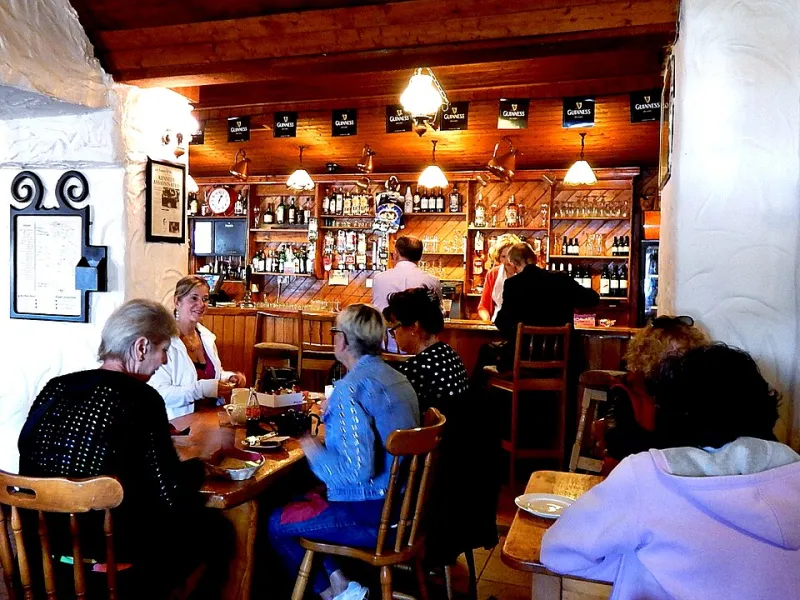
Photo: Suzanne Mischyshyn , CC BY-SA 2.0, via Wikimedia Commons
There is a moment in every good pub session when you stop looking at the beer and start looking at the floor. Perhaps you have dropped a coaster. Perhaps you are trying to work out whether the pattern is moving or whether that is just the lighting. Either way, the carpet has you. And once you are in, there is no getting out.
Britain's pub carpets are not merely floor coverings. They are mood boards, warning labels, wear diaries and accidental artworks, all rolled into one sticky-backed expanse. They have absorbed more history than most museum textiles, and they ask for nothing in return except that you do not scrape your chair across them.
First, Look Down
The carpet is the most honest thing in the building. The hand pumps can be polished. The menu can be laminated into a fantasy of local sourcing. The log fire can be switched on in October. But the carpet cannot pretend. It shows you where people walk, where they linger, where they have spilled, and where the cleaner has given up.
A quick downward glance tells you more about a pub's age and ambitions than a framed photograph of the original landlord ever will. New carpets tend to be cautious: dark blue, tight geometric repeat, the sort of thing chosen by a committee. Old carpets are braver. They have seen things. They have a colour palette that suggests the designer was briefly unsupervised.
The Pattern Is the Point
The classic British pub carpet is a swirling, saturated thing. It might feature stylised flowers, faux-medieval flourishes, or abstract loops that look like a graph of the national mood. The pattern is usually so busy that it becomes camouflage. A dropped crisp vanishes. A small puddle of beer becomes a design feature. This is not an accident. It is practicality dressed up as decoration.
Look closely at the repeat. A carpet with a tight, small-scale repeat often dates from an era of brewery-mandated refits, when every pub in a region was given the same floor and told to be grateful. A larger, looser pattern suggests a later, more independent hand, or a landlord who went to a trade show and came back changed.
Wear Paths: A Map of Human Need
The real information is in the wear. Every pub has a geography of thirst, and the carpet records it in flattened pile and darker patches.
The path from bar to door is usually the most direct. It tells you where the pub expects people to arrive and leave, and whether they tend to do so in a straight line. The path from bar to loo is more interesting. It is often longer than it needs to be, because it has been shaped by tables, fruit machines and the need to avoid eye contact with someone you owe money to.
Then there is the quiz corner, the function room threshold, and the mysterious patch in front of the fireplace that is worn thin by people warming their backsides. If you see a small, intensely flattened circle near the bar, that is where the regulars stand. They have been standing there for years. The carpet has accepted it.
The Sticky Patch and Other Diagnostics
A pub carpet can be read through the soles of your shoes as much as through your eyes. The sticky patch is a diagnostic tool. Too sticky and you are looking at a cleaning regime that relies on hope. Not sticky at all and you may be in a pub that has recently been refurbished into a place where nobody is allowed to have fun.
The smell is part of the text, too. A faint whiff of old beer and lemon cleaner is normal. A sudden note of wet dog suggests a pub that welcomes everyone. A sharp chemical smell may mean the carpet has just been shampooed, which is either good news or a warning that something has happened.
A Field Guide in Five Glances
- The edging. Smart, recent edging suggests pride. Frayed edging suggests history. Missing edging suggests a story you probably do not want to hear.
- The colour temperature. Warm reds and golds feel traditional. Cold blues and greys feel like a conference hotel. Acid greens and purples feel like 1978, and are all the better for it.
- The pile direction. Run your hand across it if nobody is looking. A carpet that has been vacuumed in one direction is a carpet that is cared for. A carpet with no direction at all is a carpet that has given up.
- The threshold. The strip by the door is the first thing to fail. If it is intact, the pub is either new or fiercely maintained. If it is held down with gaffer tape, welcome in.
- The pattern density. Busy patterns hide more than stains. They also hide the fact that the carpet is the only thing holding the room together.
The Carpet as Accidental Folk Art
There is no credited artist behind most pub carpets. They were commissioned by breweries, produced in bulk, and laid by people who were probably in a hurry. Yet they have a visual language of their own: optimistic, slightly chaotic, and deeply regional in ways that are hard to prove but easy to feel.
Seaside pubs often lean blue and sandy. City centre boozers seem to favour deep reds and browns, as if the carpet is trying to absorb the traffic. Rural pubs can be surprisingly bold, perhaps because there is less else to look at. None of this is scientific. All of it is true after two pints.
How to Conduct Yourself on the Floor
Treat the carpet with respect. Do not spill your pint on it, or at least do not announce that you have done so. Do not kneel on it to retrieve a dropped coin unless you are prepared to become part of its history. And do not, under any circumstances, attempt to identify the pattern out loud. The carpet has heard enough.
Next time you are in a pub, take a moment to look down. You are standing on a document. It is sticky, swirling and slightly ridiculous, and it knows more about the place than you do. That is the UshVP view, anyway: the best stories are often underfoot.