Four Wheels and a Grudge: The Secret Life of Britain’s Escaped Trolleys
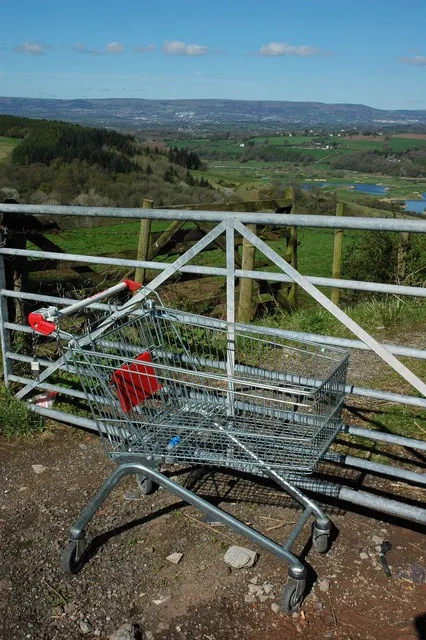
Photo: Philip Halling, CC BY-SA 2.0, via Wikimedia Commons
There is a particular sound a shopping trolley makes when it has decided to leave home. Not the chirpy clatter of a supervised trip round the biscuit aisle, but a lower, more determined rumble: one buckled wheel dragging, a loose basket rattling, a faint squeak that sounds less like machinery and more like complaint. You hear it on a wet November pavement and you know, without looking, that somewhere a supermarket has lost a soldier.
Britain is full of these escaped trolleys. They gather in canal beds, hedge gaps, stairwells, retail park verges and the front gardens of people who have quietly decided that a wire basket on wheels is a legitimate garden feature. They are not quite litter and not quite transport. They are provisional infrastructure, abandoned mid-mission.
The coin-lock economy, and why it never really worked
The coin lock was supposed to solve all this. Pop a pound in, free the trolley, get your pound back when you return it. Simple. Except the system relies on a shared sense of shame that Britain has never quite been able to sustain for more than three consecutive errands. Someone is always in a hurry. Someone always knows a bloke with a trolley key. Someone always has a euro coin that fits just well enough to be annoying.
Then there are the trolleys with the magnetic wheels that lock themselves when they cross a painted line in the car park. In theory, this is a invisible fence. In practice, it creates a small zone of chaos near the boundary where trolleys stop dead, shoppers abandon them, and a new generation of rogue trolleys is born. The line is meant to keep them in. Mostly it just gives them a starting point.
A taxonomy of escape
Escaped trolleys fall into broad types. The canal trolley is the most romantic: half-submerged, algae-draped, occasionally mistaken for a shopping basket by a passing heron. The hedgerow trolley is the most rural, wedged into a hawthorn gap with the resigned air of a creature that has chosen its final burrow. The stairwell trolley is urban and stubborn, parked at the bottom of a block of flats as if waiting for a lift that will never come. The front-garden trolley is the most domestic: usually upside down, often used to hold pots, occasionally painted, and always defended by its new owner with the phrase “it’s handy for the compost.”
There is also the bus-stop trolley, which appears at 7.15am and is gone by 9, and the retail-park tumbleweed, which rolls across empty tarmac on windy Sundays like it’s auditioning for a Western.
The unofficial retrieval network
For every escaped trolley, there is usually someone who notices. Not the supermarket, necessarily — they have contracts and collection vans and a weary acceptance that some trolleys are simply gone. No, the real retrieval network is informal: the bloke with a van who collects them for scrap, the canal trust volunteers who haul them out during clean-ups, the neighbour who rings the store every third week and says, with genuine concern, “One of yours is in the brook again.”
Some areas run trolley amnesties. Others rely on apps and hotlines. A few rely on the time-honoured method of seeing a trolley in the street, sighing, and walking past it for six months until it becomes a landmark. There is a fine line between civic duty and accepting that the trolley at the end of the road is now part of the local heritage trail.
What a trolley’s resting place says about your town
A trolley’s final position is oddly revealing. A canal trolley suggests a town with a nice waterside walk and a supermarket too close to the towpath. A hedgerow trolley hints at a park-and-ride that got ambitious. A stairwell trolley speaks of flats, deliveries and a lift that has been “temporarily out of order” since the spring. A trolley in a front garden is a small monument to thrift, chaos or both.
In November, the clues get clearer. Wet pavements make trolley wheels behave differently — the wonky ones skid, the straight ones track water into the shop, and the abandoned ones leave little rust-coloured trails on the concrete like a reluctant signature. The early dark makes escape easier. A trolley can slip away at 4.30pm and be halfway to the ring road before anyone notices.
Wet-pavement season
This is peak trolley season. The supermarket car park is slick, the trolley bay is full of damp receipts, and the wind has a way of nudging an empty trolley into a slow, graceless roll across the tarmac. If you see one on the move, give it room. It has no insurance and even less sense of direction.
And if you find one outside your house this November, you have choices. You can ring the store. You can walk it back. You can use it to carry the recycling out. Or you can do what a surprising number of people do: turn it upside down, put a plant pot on it, and pretend you meant it. No judgement here. The trolley has already made its own choices. You are simply providing a retirement plan.
At UshVP, we like to think of these four-wheeled wanderers as Britain’s most honest form of public art: accidental, weather-beaten and always slightly in the way. Keep an eye out on your next wet walk. The trolley you pass may look abandoned, but it is probably just between errands.