Roundabout Roulette: Ten Civic Sculptures Worth a Deliberate Wrong Turn
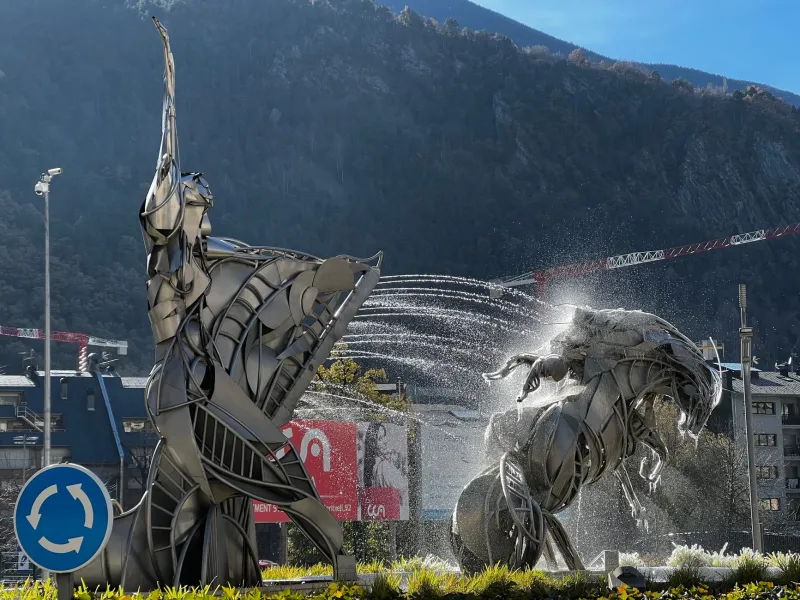
Britain has a funny relationship with the roundabout. We treat it as traffic furniture, a place to practise lane discipline and mutter at people who indicate after the exit. But look left while you queue and you will notice something odd: a lot of them have art. Not museum art, not gallery art, but civic sculpture built to be seen at 30mph between a tyre fitter and a retail park. It is one of the country’s most underrated free exhibitions, and it is open all hours.
The art of going nowhere in particular
Roundabout art exists because somebody, somewhere, had to make a junction feel like a place. A new housing estate needs a gateway. A bypass needs a landmark. A business park needs to pretend it is not just a business park. So the sculpture goes in, usually after a planning condition, sometimes after a public art strategy, occasionally after a committee meeting that ran past everyone’s bedtime.
The result is a peculiar genre. It has to be visible from a moving car, robust enough for weather and pigeons, and vague enough not to cause a pile-up. It should not be so interesting that drivers stop to look. It should not be so dull that everyone forgets it exists. The sweet spot is a piece that makes you think, briefly, that you have arrived somewhere, even if that somewhere is the ring road.
Who actually pays for the fibreglass horse?
Follow the money and you usually find a developer contribution, often called Section 106 money, tied to a new estate or supermarket. Sometimes it is council public art cash, a parish council project, a business improvement district, or a crowdfunding push led by someone with a laminator and a dream. The sculpture is rarely bought by the people who have to look at it every day, which explains a lot.
Maintenance is the awkward bit. A museum has a roof, a curator and a leak. A roundabout has a bloke with a strimmer and a willingness to ignore graffiti. When the paint fades or a wing falls off, the argument starts. Is it art, or is it a hazard? Do we restore it, or do we quietly replace it with a shrub? This is where local affection becomes powerful. A town will rally round a fibreglass horse with a wonky ear far faster than it will rally round a museum display case. The horse is on the school run. The museum is on a list of things people mean to visit.
Ten to miss your exit for
Not every entry is technically a roundabout sculpture. Some are junction art you see from one, which is close enough. The point is the same: a piece of public art that has become part of the local mental map.
-
The Angel of the North approach, Gateshead. The Angel is not a roundabout sculpture, but the A1 junction gives you the full wingspan at exactly the right speed. It is the rare piece of public art that works as a sat-nav landmark and a genuine jolt. You see it, you know where you are, and you briefly forget you are in a queue.
-
The Concrete Cows, Milton Keynes. The city’s most famous herd sits near the grid roads, doing what concrete cows do best: looking slightly surprised to be there. They are daft, they are beloved, and they make a roundabout approach feel like a field trip. Whether they are good art is almost beside the point. They are Milton Keynes.
-
The Steel Man, Consett. A towering figure of welded metal, visible from the road and built to honour the area’s steelworking past. It is the kind of sculpture that makes a retail park feel briefly epic. You come for the car wash, you leave thinking about industry and decline and the strange dignity of a big bloke made of girders.
-
Basingstoke’s steel knot. Basingstoke has enough roundabouts to qualify as a sport, and several of them have public art that looks like a dropped coat hanger designed by an optimist. The best ones catch the light and turn a dull junction into a small event. The worst ones make you wonder if the council lost a bet. Either way, you notice.
-
The Dun Cow, Dunchurch. A village roundabout with a beast on it is always going to win. The Dun Cow is the sort of local landmark that appears on pub signs, school projects and directions given by people who have never used a postcode. It is not grand. It is not famous. It is simply there, and that is enough.
-
The Iron Horse, Workington. A metal horse near the road is a strong start, because horses are excellent roundabout material: recognisable, sturdy, and just odd enough to make you look twice. This one nods to the area’s industrial and transport history without requiring a plaque to enjoy. You can get the point at 30mph, which is more than most art can manage.
-
The Willow Man, Bridgwater. A huge willow figure beside the M5, visible from the junction roundabout and weirdly moving in the wind. It is public art as landmark, the sort of thing you look for on long journeys. It also proves that roundabout-adjacent art does not have to be bronze or steel. Sometimes it is a giant gardener made of sticks.
-
The Kelpies, Falkirk. Yes, they are near a major junction rather than sitting on a traffic island, but the approach gives you the full horse-head drama. They are huge, shiny and completely unmissable. If a town is going to spend serious money on roadside art, this is the argument for doing it properly.
-
The retail-park horse, various towns. You know the one. Fibreglass, slightly glossy, painted by a local artist, standing on a plinth outside a cinema or a garden centre. It is not going to win the Turner Prize, but it has a name, a Facebook page and a Christmas hat in December. These are the sculptures people actually talk to.
-
The mystery abstract on your own ring road. Every town has one: a stack of steel rings, a wonky pyramid, a thing that looks like a giant shuttlecock. Nobody knows who made it. Nobody knows what it means. But if it were removed tomorrow, the letters page would be furious. That is the test of civic art.
Why the horse beats the museum
A museum asks something of you. It asks for opening hours, an entrance fee, a quiet voice and a willingness to learn. A roundabout sculpture asks nothing. It is there when you pop to the tip, when you drop the kids at school, when you are lost and looking for a retail park. It belongs to everyone because nobody owns it. That is why a fibreglass horse can become a mascot while a perfectly good local museum struggles to get a mention in the council newsletter.
So next time you are stuck at a junction, look left. There may be a steel loop, a concrete cow or a horse with a wonky ear. It is not the Tate. It is better than nothing, and sometimes it is the best thing on the whole drive.